January 19, 2026

Introducing the Impact Heroes Class of 2026

From August to October 2025, Earth Company received applications from changemakers across the Asia-Pacific region—leaders with bold vision, deep commitment, and the courage to tackle some of the most pressing social and environmental challenges of our time.

After a rigorous, almost five-month selection process, including detailed reviews, interviews, and shortlisting from an exceptional pool of 105 applicants, we are proud to announce the Impact Heroes Class of 2026: nine outstanding changemakers selected for their leadership, impact, and potential to drive systemic change.

These Heroes are building solutions rooted in their communities, advancing justice, protecting ecosystems, and shaping pathways toward a more regenerative future.

Our One-Year Commitment: Nurturing Regenerative Leaders

Over the next 12 months, the Impact Heroes Class of 2026 will take part in Earth Company’s Lead-to-Regenerate (L2R) Changemaker Program—a one-year journey designed to strengthen leadership, deepen impact, and support long-term sustainability.

Through L2R, each Impact Hero receives tailored support to grow as a regenerative leader, expand their network, and access resources aligned with their unique needs and context. The program consists of:

  1. Online Sessions

A series of monthly online sessions from January to June, where Impact Heroes explore regenerative leadership, alongside practical knowledge needed to accelerate their impact and organizational development.

  1. Heroes Camp in Bali

An all-expense-paid, five-day immersive camp in Bali, bringing together the cohort, Earth Company team, mentors, and collaborators. The camp creates space for deep connection, reflection, and co-creation. Read about last year’s camp here.

  1. Mentorship

Each Impact Hero is matched with mentors based on their specific support needs—ranging from leadership and strategy to business development, communications, and fundraising.

  1. Opportunity Building

Earth Company actively connects Impact Heroes to relevant opportunities across its global network, supporting partnerships, visibility, and access to resources as needs arise.


These nine exceptional individuals will become part of our Impact Heroes Class of 2026, who will participate in our Lead-to-Regenerate (L2R) Changemaker program for the next 12 months.

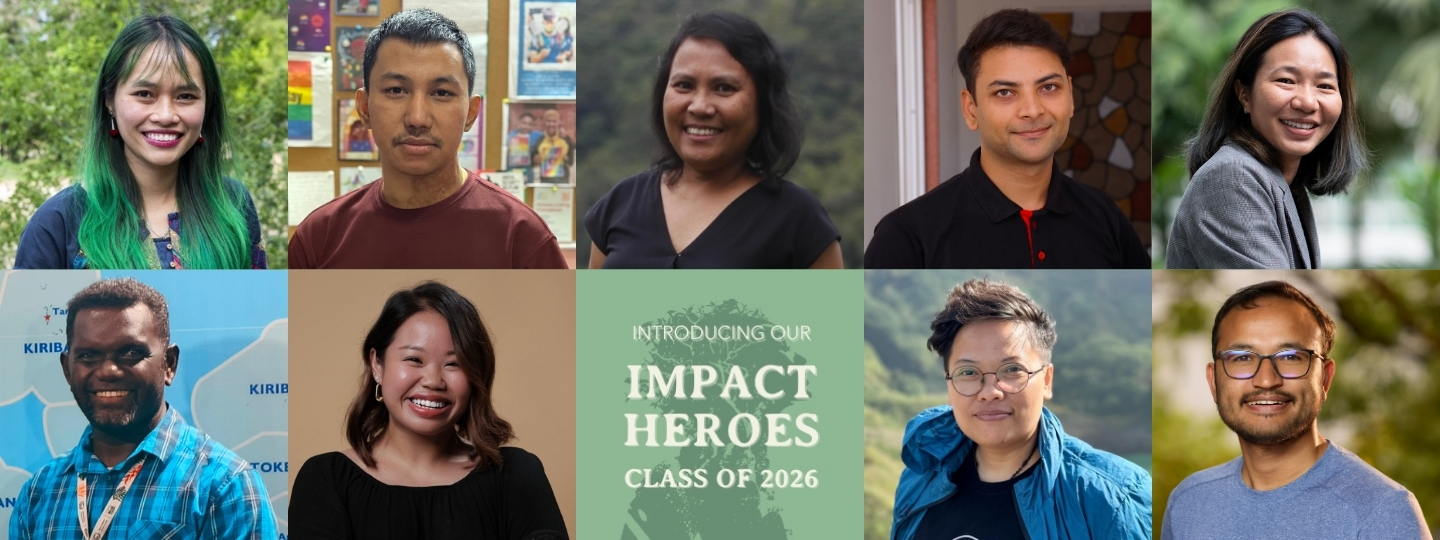
Introducing: the Impact Heroes Class of 2026!

Aaditya Rai

Focus geography: Nepal
Organization: Rainbow Disability Nepal
Mission: Empowering LGBTQ+ persons with disabilities through advocacy, inclusion, and leadership for equality, dignity, and transformative community change.


Aaditya is the first person in Nepal to publicly come out as both disabled and gay. As a teenager, he was expelled from an orphanage and lost his education scholarship, forcing him to survive without family or institutional support before later completing a bachelor’s degree in social work and working with an LGBTI organization.

In Nepal, LGBTQ+ persons with disabilities face layered discrimination and are often excluded from both LGBTQ+ and disability communities. Many are denied access to education, housing, and employment, while weak legal protections and inaccessible infrastructure further marginalize queer persons with disabilities.

In 2022, drawing on his lived experience, Aaditya founded Rainbow Disability Nepal, the country’s first and only organization dedicated to queer disability rights. Through advocacy, leadership training, counseling, education support, and community programs, the organization has supported hundreds of LGBTQ+ persons with disabilities and amplified their voices in policy and public spaces.

Fainta S. Negoro

Focus geography: Indonesia
Organization: Jaga Semesta
Mission: Restoring water resources and equipping communities to protect water, preserve traditions, and secure a regenerative future for people and planet


Fainta grew up facing water scarcity and, since 2010, has worked in hydrogeology and corporate water stewardship. In 2023, realizing these approaches were not keeping pace with Indonesia’s worsening water crisis, she left her senior role and traveled across Java and Bali to document the condition of springs and rivers—an experience that led her to found Jaga Semesta.

Indonesia is projected to face a severe water crisis by 2040, with Java at the highest risk. Forest loss, climate change, and increasing runoff are reducing groundwater recharge, while water-scarce areas continue to expand and droughts intensify across the island.

Through Jaga Semesta, Fainta works with local communities to restore springs, plant endemic trees, and recharge aquifers. What began as a solo journey has grown into a nationwide movement with 10 chapters, helping communities secure sustainable access to water for people and nature.

Girish Mehta

Focus geography: India
Organization: CareLeavers Inner Circle (CLiC) Forum
Mission: Creating a world where no young person is orphaned twice.


Girish grew up as a child laborer before entering an orphanage in 2007, an experience that transformed his life and opened access to education. When he aged out of care at 18, he felt “orphaned again,” navigating adulthood without guidance or support. While working to rescue children from labor and early marriage, he began to see how thousands of young people leaving institutional care faced the same struggles he had experienced.

Each year, 30,000–50,000 youth exit childcare institutions across India with limited life skills, insecure housing, missing identity documents, and little awareness of aftercare support. Fragmented government programs and a lack of mentoring leave many care leavers without the tools needed to build stable and independent lives.

In response, Girish founded CLiC Forum, a care-leaver-led platform connecting youth to housing, education, jobs, legal identity, and mental health support. Through a digital portal, helpline, and 48 partners nationwide, CLiC has supported over 3,000 care leavers and is working with state governments to build India’s first nationwide safety net for young people leaving care.

Heidy Quah

Focus geography: Malaysia
Organization: Refuge for the Refugees
Mission: Restoring dignity and hope through education, advocacy, and opportunity, empowering displaced communities to rebuild thriving futures.


When she was a teenager, Heidy began her human rights work after witnessing refugee children in Malaysia living in fear, without access to education or basic dignity. What started as an effort to keep a refugee classroom from closing grew into Refuge For The Refugees (RFTR), a movement she founded to stand alongside refugee communities despite mounting risks and resistance.

In Malaysia, refugees have no legal recognition and are denied the right to work, formal education, and affordable healthcare. Long registration delays, corruption, and rising xenophobia leave refugee families vulnerable to arrest, exploitation, and violence, while frontline advocates face increasing pressure and threats.

Through RFTR, Heidy has helped provide education to over 5,000 refugee children, dignified healthcare to more than 700 patients, and livelihoods for refugee women and survivors of sexual and gender-based violence. Today, RFTR supports 35 refugee learning centres, shelters, healthcare access, and women’s livelihood programs, while continuing to advocate for policies that protect—rather than punish—people seeking safety.

Hendrick Kaniki

Focus geography: Solomon Islands
Organization: Sirubai Voko Tribe Association
Mission: Maximizing and managing natural resources sustainably towards food security and conservation for communities


Hendrick grew up in Pusiju Village on Vella La Vella Island, where he learned the values of service, unity, and care for community. After six years of medical training in Fiji and a decade working as a government medical superintendent, he returned home to serve his people—now the only medical doctor for over 5,000 residents and providing voluntary care on weekends.

In the Western Province of the Solomon Islands, communities face escalating ecological pressures, including illegal logging, deforestation, overharvesting of marine resources, pollution, and climate crisis impacts. In Pusiju Village, logging has contaminated water sources, climate change is eroding land and homes, and limited, costly transport restricts access to markets—threatening health, food security, and livelihoods.

Through the Sirubai Voko Tribe Association, Hendrick works with local communities to strengthen education, gender equity, sustainable livelihoods, and environmental stewardship. By combining medical expertise with grassroots leadership and advocacy, he is helping build long-term resilience while preserving the natural resources and cultural foundations of village life.

Kumar Paudel

Focus geography: Nepal
Organization: Greenhood Nepal
Mission: Saving Nepal’s most threatened and neglected wildlife and their habitats.


Kumar grew up in a village along the Nepal–China border, surrounded by wildlife and forests. As a child, he witnessed pangolins being killed and trafficked for the illegal wildlife trade—experiences that shaped his lifelong commitment to conservation. After studying biodiversity in Kathmandu and later at Oxford, he founded Greenhood Nepal to protect the species and ecosystems that defined his early life.

Nepal is a global biodiversity hotspot, home to nearly 3% of the world’s species, yet illegal poaching and wildlife trafficking pose serious threats. Pangolins, the world’s most trafficked mammals, are critically endangered, with an estimated 17,000 individuals poached each year, pushing already fragile populations toward collapse.

Through Greenhood Nepal, Kumar advances science-based conservation by generating research, shaping policy, and strengthening the conservation community. Over the past 13 years, the organization has reached more than 10 million people, trained 1,200 officials to combat wildlife crime, and produced 30 peer-reviewed studies to support long-term protection of Nepal’s wildlife and habitats.

Nerlian Gogali

Focus geography: Indonesia
Organization: Institut Mosintuwu
Mission: Building a just and sovereign life for humanity and nature.


Lian was born in Poso and returned home after the communal conflict to document the overlooked experiences of women and children. While her research revealed both layers of violence and moments of interfaith solidarity, a question from a woman in a refugee camp—about how research would change their lives—pushed her to move beyond documentation and toward action.

The Poso conflict, often framed as religious violence but driven by deeper political and economic interests, left lasting social and environmental damage. Women bore the heaviest burden, facing displacement, loss of livelihoods, insecurity, and sexual and psychological violence. Largely excluded from peace processes, many women were left without access to education, economic opportunities, or decision-making spaces—impacts that continue to shape daily life in Poso.

In response, Lian founded Institut Mosintuwu to strengthen peace and gender justice through grassroots education. Through the Women’s School and its evolution into the Women’s Village Reform School, over 520 women have built leadership skills, rights awareness, and interfaith solidarity—helping rebuild trust, address trauma, and advance post-conflict development rooted in justice and care for nature.

Trang Nguyen

Focus geography: Vietnam
Organization: WildAct Vietnam
Mission: Empowering communities and promoting sustainable, innovative conservation


When Trang was eight years old, she saw a bear confined in a tiny cage and promised herself she would protect wildlife. Growing up in Vietnam, that dream felt distant—opportunities in conservation were limited, and women were rarely seen in leadership roles. In 2013, while undergoing cancer treatment, she founded WildAct to make conservation more accessible, inclusive, and grounded in local leadership.

Vietnam’s biodiversity continues to face severe threats from illegal wildlife trade, unsustainable hunting, habitat loss, and weak law enforcement. Traditional conservation approaches often exclude women, ethnic minorities, and local communities, limiting participation and leaving those closest to nature out of decision-making.

Through WildAct, Trang empowers local leaders and communities to protect wildlife and habitats through evidence-based programs that address poaching, habitat loss, and systemic inequality. By investing in local capacity and creating pathways for communities to lead conservation efforts, WildAct is building a movement where people become long-term guardians of Vietnam’s natural heritage.

Watcharapon Kukaewkasem (Sia)

Focus geography: Thailand
Organization: Freedom Restoration Project
Mission: Eliminating gender-based violence and empowering women through sustainable, survivor-centered programs.


Sia was born into an Akha migrant family along Thailand’s border, where she grew up witnessing her father’s abuse toward her mother—violence met with silence because her mother could not speak Thai and had nowhere to turn. Through education, healing, and personal growth, Sia came to believe that her experiences could be transformed into strength for others.

In Thailand’s border communities, domestic violence is widespread and often normalized, while Myanmar migrant women and children face heightened risk. Without legal status, language skills, or financial independence, many survivors have little access to protection systems or shelters and remain trapped in abusive situations for fear of detention, deportation, or losing their children.

In 2017, Sia founded the Freedom Restoration Project (FRP), a survivor- and women-led organization providing the only long-term shelter and holistic support for migrant survivors of gender-based violence along the Thai–Myanmar border. Serving primarily undocumented Myanmar migrants, FRP has supported over 400 women and children through safe housing, counseling, mental health care, and vocational training—helping survivors rebuild their lives with dignity and independence.