

[Update] A Look at the One-Year Impact of the Impact Heroes Class of 2024

1. Next-Generation Education Development (India)

Deepak Ramola is a researcher and practitioner dedicated to documenting “life wisdom” and creating education that helps people “live well.” As modern society rapidly evolves, many communities are losing the traditional cultures and nature-based wisdom that have been passed down for generations.
To address this, Deepak organized a two-month online program for 12 teachers and educators across India. The goal was to preserve these cultural stories and local knowledge by transforming them into children’s picture books that can be shared with future generations.
Through the program, eight picture books were created. These books were distributed in the participants’ schools and public libraries, and through community read-aloud events that reached more than 700 children.
One participant noted, “I realized that to nurture children’s creativity, teachers themselves need to become storytellers. This program helped me rediscover my role as an educator, and I’m now inspired to start a read-aloud club for my students.”

Left: Through eight online sessions, participants learned how to transform local wisdom into picture-book stories.
Center: A picture-book exhibition was held at a local literature festival, attracting more than 100 visitors.
Right: Teachers held read-aloud sessions using the picture books they created.
2. Financial Inclusion for Low-Income Communities (India)

Lian Thangvung is making lifesaving healthcare accessible for India’s poorest communities through innovative health-financing solutions.
In India, many low-income households lack access to basic financial services—they often cannot open bank accounts, have no credit history, and are therefore excluded from loans and insurance. When a medical emergency strikes, families are forced to borrow from loan sharks at extremely high interest rates, trapping them in debt and pushing them into deeper poverty.
Lian’s organization, QONECT, tackles this challenge by offering collateral to financial institutions on behalf of users. This enables families to access same-day medical loans and small microcredits, even without a bank account or credit history.
Thanks to this grant, 47 additional people were able to join QONECT’s financial service. One of them was Ryan, a security guard in his 30s living in Manipur, who rushed his kindergarten-aged child to the hospital after a sudden collapse. With limited savings and no clear way to pay for urgent treatment, he feared the worst. At the hospital, he learned about QONECT and applied immediately. He was approved the same day and received the equivalent of around USD 300 in a medical loan—enough to ensure his child received timely care. His child recovered safely, and the family avoided financial ruin.
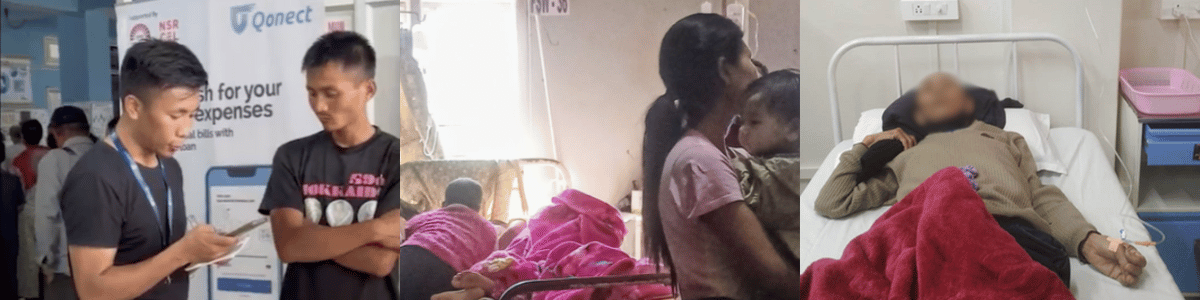
Left: Lian explaining QONECT’s same-day medical loan service to a father whose son has fallen ill.
Center: A patient who was able to be hospitalized thanks to a medical loan.
Right: An elderly resident of conflict-affected Northeast India who secured a loan to cover transportation and medical costs.
3. Developing the Next Generation of Environmental Leaders (Philippines)

Bobby Chan is an environmental lawyer who has risked his life to protect the natural treasures of Palawan Island—known as the “last ecological frontier” of the Philippines.
Home to extraordinary biodiversity and countless endemic species, Palawan’s forests and seas face escalating threats from illegal logging and illegal fishing. Bobby’s organization, the Palawan NGO Network (PNNI), monitors forests and coastal areas, intervenes to stop environmental crimes based on environmental law, and even confiscates chainsaws, dynamite, and other equipment used for destructive activities.
In 2025, PNNI focused on cultivating the next generation of environmental defenders. They conducted three intensive trainings for six student interns, where Bobby himself taught legal frameworks and proper intervention methods. The interns also visited forest sites under PNNI’s surveillance to witness the realities on the ground.
One participant has since become a dedicated volunteer supporting PNNI’s legal department—now playing an active role as part of the team!

Left: Bobby giving a hands-on lesson directly to young people on the frontlines.
Center: Interns visiting the remote forest sites monitored by PNNI.
Right: An intern holding up an environmental advocacy T-shirt, sharing the cause with fellow youth.

4. Tackling Hunger in Rural Communities (Philippines)

Ayesha Vera-Yu, who left a career in New York’s finance industry, is bringing transformative change to poor communities across the Philippines.
In rural areas of the Philippines, one in four people lives in poverty, surviving on the equivalent of less than USD 1.6 per day. Ayesha’s organization, ARK, has developed a community-based barter system where families grow vegetables in home gardens and exchange their harvests with neighbors—allowing them to secure food without relying on cash. Working closely with local governments and communities, ARK is scaling this model as a sustainable solution to poverty across the country.
With this grant, ARK delivered its program to 5,123 households across six municipalities.
Voices from the community:
“In just two weeks, I harvested 29 kg of vegetables. I exchanged the extra produce for other food items and even sold some to earn income. We used to eat only canned goods and instant noodles, but now I can cook nutritious meals for my children. With the extra income, I can also pay for school fees and buy milk for my kids!”

Left: Barter events held across 22 administrative districts in six municipalities.
Center: The “Feedback Program,” where families bring their harvested vegetables to exchange within the community.
Right: Each family brings about 3 kg of vegetables to share and exchange with one another.
5. Protecting Lilisiana's Coastline (Solomon Islands)

Millicent Barty is working to protect the traditional cultures of the Solomon Islands, which are increasingly threatened as rising sea levels swallow coastal land.
In Lilisiana, Malaita Province—one of her key project sites—severe coastal erosion has already claimed 23 meters of shoreline. As an emergency measure, Millicent collaborated with local residents to build simple coastal barriers using coconut trunks, stones, and sandbags. Later, they constructed a more durable temporary barrier using drums and cement, while laying plans to secure government funding for full-scale coastal protection in the future.
With support from this grant, Millicent organized a joint meeting with government officials, village chiefs, and community leaders. By presenting the situation directly and advocating for support, she secured approximately USD 146,000 from the national climate change budget. The government has now formally approved a three-year project to build coastal protection infrastructure along 60 meters of shoreline.

6. Keeping voices alive through comedy and community (Indonesia)

Sakdiyah Ma’ruf is working to support women and young people in Indonesia who have experienced domestic and sexual violence, using comedy as a tool for healing and empowerment.
As Indonesia’s first Muslim female stand-up comedian and the founder of Our Voice Comedy for Change, Sakdiyah creates safe spaces where survivors can build confidence, express themselves, and connect through performance. Many participants face stigma and limited access to platforms where their voices can be heard.
With support from this grant, Sakdiyah delivered an Our Voice Comedy training for 25 women and youth and supported four women alumni to perform at two major public events in Jakarta, including an International Youth Day event with UNFPA and the launch of the 16 Days of Activism Against Violence Against Women. These performances reached over 100 audience members and increased the visibility of survivor-led voices. Part of the grant also supported a small library and creative space for 10 girls in Sakdiyah’s home village.
7. Community Building and Livelihood Support for People Living with HIV (Indonesia)

Scott Alfaz, an HIV-positive influencer, is dedicated to providing vital information and support to people living with HIV who face significant challenges in Indonesia.
Stigma and discrimination remain deeply rooted, making it difficult for many HIV-positive individuals to find work. Many also struggle in isolation, unable to confide in those around them, which often leads to severe mental distress. As someone living with HIV himself, Scott understands these struggles firsthand.
He launched a six-month online program focused on community building and entrepreneurship for people living with HIV. A total of 36 participants joined—30 of whom are HIV-positive. The program included small-group sessions for sharing personal challenges, as well as webinars covering the basics of starting a business.
Thanks to the training, two participant teams successfully launched their own businesses, from planning through to sales, enabling them to begin generating their own income.

Left: Scott sharing his personal experiences with participants during an online session.
Center: Ari (pseudonym) developed a line of instant noodles and secured sales channels through food-delivery apps.
Right: Mahindra (pseudonym) created a health drink inspired by traditional jamu, selling through pop-ups and e-commerce platforms.
[Update] Grants Awarded to the Impact Heroes Class of 2025!

Thanks to the generous support of our Earth Lovers community, we are delighted to share that this year’s grants for our new heroes have been confirmed!
Just like last year, eight Impact Heroes—including Freshta Karim, the Impact Hero 2025—will each receive a grant of USD 3,000, totaling USD 24,000.
We will soon be introducing each of the selected projects in more detail. We look forward to sharing how these heroes will use the grants to pave the way toward a regenerative future across the Asia-Pacific region.
We are also welcoming new Earth Lovers, our monthly supporters who stand alongside our heroes year-round. With a contribution starting from ¥1,500 per month, you can help empower extraordinary changemakers tackling pressing social and environmental challenges across the region.